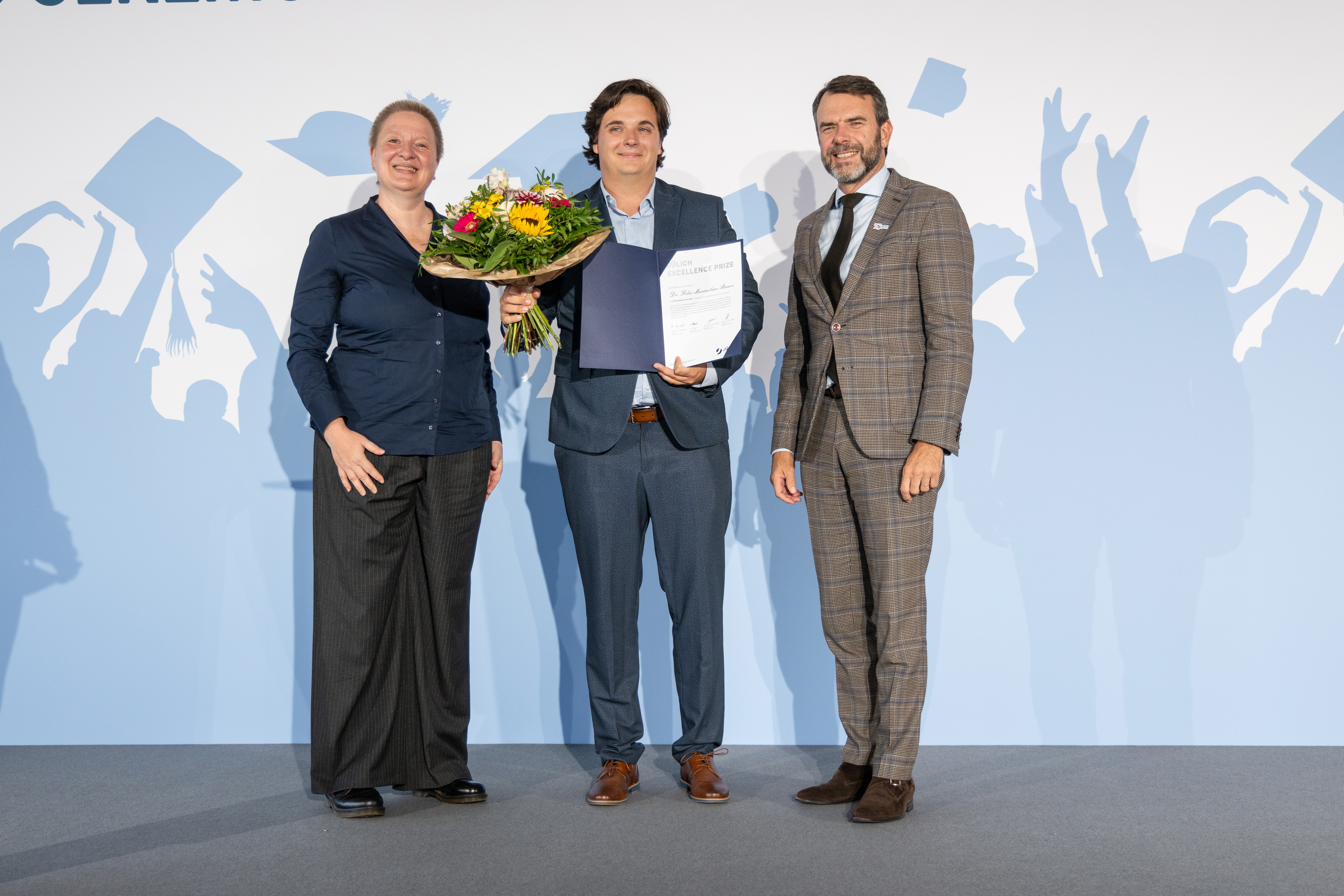
When I started my PhD, I certainly didn’t expect that a few years later I would be receiving the Jülich Excellence Prize. So, when I learned that I had been selected for the 2026 award, I was genuinely surprised and, of course, very happy! On 14 September, I had the pleasure of receiving the prize at Forschungszentrum Jülich, recognising my research during my PhD and early postdoctoral career.
The Jülich Excellence Prize is one of Forschungszentrum Jülich’s most prestigious awards for early-career scientists. Established in 2009, it recognises exceptional research achievements during the PhD and early postdoctoral years. The selection process is highly competitive, with candidates expected to rank among the top 5% of researchers at a similar career stage in their respective fields. Nominations are evaluated by an internationally composed selection committee, involving external scientific experts, with particular emphasis on scientific originality, impact, and international recognition. Knowing how high the standards are makes receiving this award even more special to me.
The occasion gave me a nice opportunity to look back at what has been a rather exciting few years. A lot of time spent in the field, in the lab, and in front of a computer, with experiments that worked, models that didn’t, and quite a few unexpected findings along the way.
Much of this work has been about a part of plants that usually remains hidden beneath our feet: their roots. How do plants respond to drought or nutrient shortages? What determines how efficiently they can take up water? And how can we study something that is so difficult to observe? To tackle these questions, I have combined experimental plant research with artificial intelligence and computational modelling. One of the most fascinating findings was how strongly a lack of phosphorus can affect the ability of maize plants to take up water. A good reminder that plants rarely respond to environmental challenges in isolation!
Since finishing my PhD, my research has gradually moved from individual roots and plants to the scale of entire agricultural ecosystems. Today, I work on digital twins and ecosystem models to investigate how regenerative farming practices influence soil carbon, crop growth, and the resilience of agricultural systems. It is quite a change in scale, but the same curiosity about how plants interact with their environment continues to drive my work.
Looking back, one of the best parts has been working with people from so many different scientific backgrounds. Research is very much a team effort, and I have been fortunate to work with some excellent people.
I am really pleased about this recognition and grateful to everyone who contributed to the work behind it. And with plenty of interesting questions still ahead, I am looking forward to what comes next!
Read more details in English and German.
🔗 Read more details in English
Mehr Infos in deutsch: